

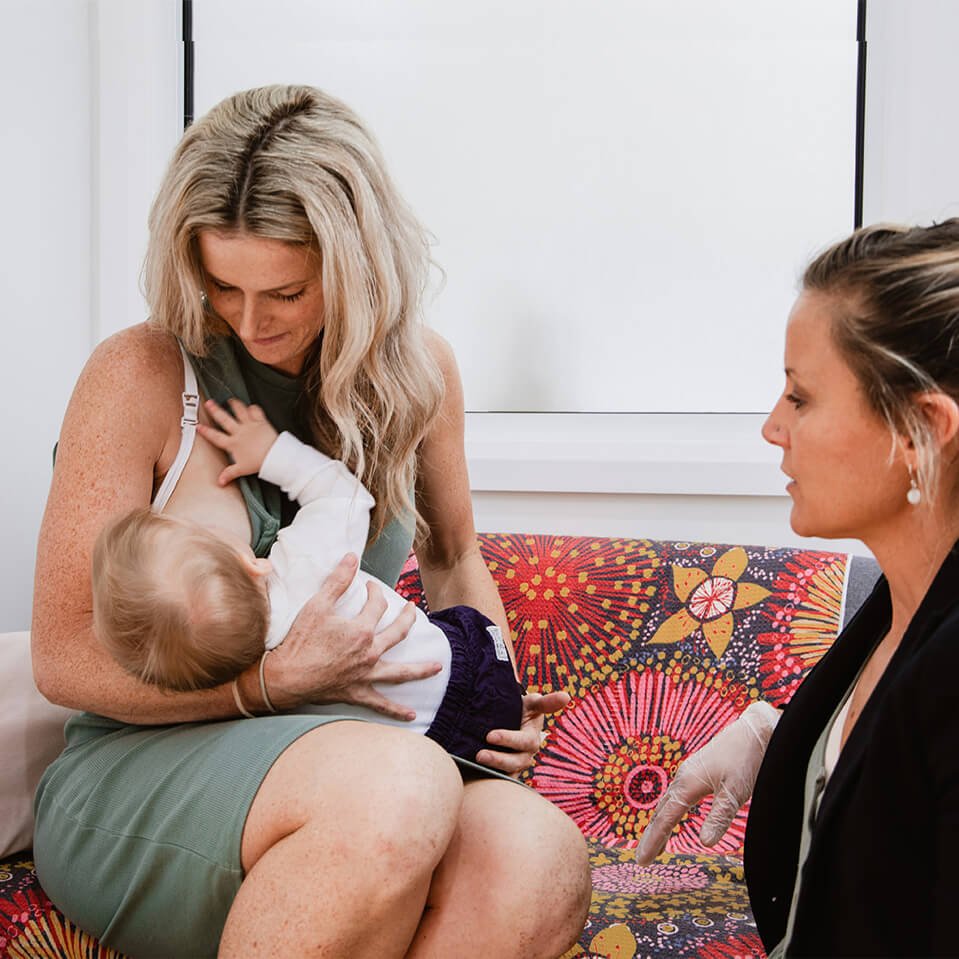
Support for tongue, lip and buccal tie revision
Your child has been assessed by one of our specialist providers as having a tongue, lip, or buccal (cheek) tie, or a combination of ties.
At Thrive, we understand the information given to you at your Assessment Appointment is a lot to take in, particularly amongst the chaos of parenting. Let this page serve as a reminder of some of the information shared with you at your appointment. If you need any clarification, please reach out to our helpful team at admin@thrivehealth.au
Below, you will find a list of tips we have compiled to help you prepare for the release procedure if you have chosen to have the ties revised.
What is a ‘tongue tie’?
Tongue-tie, or ‘Ankyloglossia’, is a condition in which the thin piece of skin under the tongue (the lingual frenulum) is tight and causing restriction of the movement of the tongue.
Restricted movement can make essential functions like swallowing, eating, speaking, and breathing more challenging. It may also lead to poor posture, and contribute to many lifelong health concerns.
Your child may also have frenulum connecting their lips (labial) or cheeks (buccal) to their gums.
Not all frenulums/frenula cause restriction. Many healthcare professionals working with infants and toddlers are primarily familiar with just the more ‘obvious’ tongue ties that extend to the tip of the tongue or create a heart-shaped appearance. However, most ties are less obvious, making them difficult to detect if you are not highly skilled and highly experienced in this exact area. The less ‘obvious’ ties, often located beneath the mucosa or skin, are known as posterior tongue ties. Accurate diagnosis requires assessment by a clinician or healthcare provider experienced in identifying them. While numerous assessment tools and classification scales exist, there is still no universally accepted standard for evaluating and managing tongue ties.
Our practitioners are expertly trained, and able to determine if a procedure may be warranted. If surgery is required it is called a tongue tie release or a Frenectomy. The operation involves releasing the skin under the tongue, either surgically with scissors (GP) or a scalpel (ENT), or with special equipment known as a ‘waterlase’ which ablates the tissue (the ONLY type of laser suitable for babies in Australia. We don’t support diode cautery).
Our practitioners can help you decide on which release provider would be best match for your child's restriction, due to their specific skillset, and your family's individual circumstances.
Next steps
Once you have chosen your provider for the procedure, we recommend that you:
Book your appointment with your chosen provider, keeping in mind the time frame our practitioner has advised. We then need to send a referral if we agree.
As soon as you have your appointment for the release, please email our team so we can schedule your follow up appointments. You MUST be prepared to see us once within the 3-5 day window post-release, and then have 3 further appointments, at weekly intervals, minimum. You may wish to book more appointments if you choose, but we require to see you for a minimum of 4 appointments in total, after the procedure. This is for wound care and ALSO to retrain feeding, tongue muscle pathways, strength, endurance, supply/flow, digestion, swallow function and breathing - valuable way beyond breastfeeding.
Begin your PRE-habilitation exercises (myofunctional therapy), as explained to you by our provider. These will have also been emailed to you after your assessment. Please complete them as scheduled for the most optimal outcome.
We recommend your baby or child consult with one of our tried/reliable bodywork providers, at least twice before the procedure. Please email us if you need suggestions. These are providers who we have vetted and seen positive results from. We are also willing to collaborate with your preferred provider, but please note that this is a specialised field and requires specific training for optimal results, specific to infant feeding, tongue tie release prep, and breastfeeding - being good at these is rare.
After the release procedure is performed, you will be required to perform RE-habilitation exercises, which will be explained to you by our providers at your first follow up appointment. These will also be emailed to you. Please complete these as scheduled.
What to expect during the procedure?
Your treatment provider should provide you with all the necessary information when booking your procedure, so that you have time to familiarise yourself with their processes. Please contact them if you have any questions about the procedure, so you have all the information you need to feel comfortable with your decision.
Remember, you are doing this in the best interest of your child, after careful and loving consideration. It is important you are feeling clear headed and confident prior to the release, so on the day you are not left wondering why you’re doing this.
On the day of the procedure, staff will confirm that you have read through the information they provided, and ask you to sign the consent form.
You should then be taken to a consultation room, where the treating provider will consult with you regarding the procedure, and explain the recommended after-care. Please ask as many questions as you need to during this consultation. You can ask for topical numbing gel to be applied in babies mouth at this time. We advocate strongly for this and have not seen any negative outcomes from using lignocaine/lidocaine gels in babies mouths. Some providers suggest it may make the baby feel stressed if they try to feed when some of the surface under the tongue feels numb, but we have not observed this in our particular experience in 15 years, over dozens of providers Australia wide and world wide.
Once you have provided consent, staff will wrap your baby (you may bring your own wrap so baby has something familiar), and a nurse or assistant will take your baby through to the treatment room.
Some babies will cry at this point, due to being with an unfamiliar person, but your baby will be held and comforted while they wait.
Staff may offer to sit with you, or ask if you prefer to wait outside. As parents ourselves, we know how heart breaking it is to hear your child cry, and how helpless you will feel. Please try to remember you are doing this for their long term health.
It’s a good idea to bring a friend, someone with a calming presence who can help you stay calm and grounded for your baby.
Focus on staying calm, and practice your preferred relaxation techniques, such as tapping, acupressure, or focused breathing. A good example is below:
Inhale: Inhale slowly through your nose for 4 seconds.
Hold: Hold your breath for 7 seconds.
Exhale: Exhale slowly through your mouth for 8 seconds.
Repeat: Repeat this cycle 4 times
The procedure will last 5 - 15 minutes, although it may feel much longer, particularly if you can hear them crying.
When your baby is brought out to you, now you can be ‘the saver’.
Be ready for a skin to skin feed, whether it’s the bottle or breast. It’s not the type of milk that matters, but the act of swallowing activates parasympathetic, rest and digest calming hormones.
Some hospitals suggest using sucrose syrup or sugar water, which you may wish to offer.
Staff should then check in with you to answer any questions, and also re-iterate the instructions given to you for wound management and follow up care.
Does it hurt?
Most babies will feel anxious at being swaddled/ restrained for the procedure, and on their back, which may also cause them to cry.
If you have opted to see a treating practitioner who uses Laser treatment, or ‘Waterlase’, this specialised equipment allows for fast yet accurate treatment. The ‘laser’ is thin as a pen, allowing for precise revision of frenulum more exactly. These methods are also thought to mean less pain and discomfort, and offer a reduction in bleeding and swelling compared to surgical methods, because the tissue is not crushed (scissors).
The procedure will only last for a few minutes though, and your baby will be back with you for a cuddle as soon as possible.
Feed immediately! Baby may need to cry and tell you all about their fright, but keep them near to feeding and settle as you read their cues. Regulate yourself! You should offer your child the breast or bottle immediately following the procedure as they often find this contact has a calming effect. If possible, try to feed baby directly from the breast, but if this is not possible, we suggest mimicking a breastfeed when offering the bottle. Bring baby in nice and close, and offer skin to skin contact if possible.
Remember your baby will need to re-learn how to use their tongue and mouth after this procedure, but this is what you’ve been working towards with your pre-hab exercises. It may take some time and perseverance, but your IBCLC can guide you through this in your upcoming appointments. The first feed will be the freest your babies tongue will ever be. It never heals 100% free as good as this range today, but we want it to be more than 90-95% free in the end! Some babies are uncoordinated straight away. They need to relearn how to use their tongue, which can take a lot of practice considering they’ve been practicing swallowing in utero from around 12 weeks gestation!
It is normal for your baby to be irritable and unsettled for the remainder of the day, and this may continue for a couple of days. It may feel worse and more achey around day 3-5 after release as the muscle fatigue and muscle ache set in from all the new marathon workout. This can be very up and down and is to be expected.
Natural protocols for pain relief are always our preferred option, but as your baby’s parent, you are the expert when it comes to their care. Please consult your treating practitioner or preferred health care provider for further options if needed.
We’re not going to lie. A frenectomy is not a pleasant experience, for baby or for parents. However, babies do have fewer nerves and less blood supply in their mouth, which will fortunately reduce the sensation of pain. No one should tell you babies won't feel it.
Healing
The mouth heals very quickly, which is why it’s so important to complete your ACTIVE WOUND MANAGEMENT holding down the floor of the mouth firmly, while lifting the tongue up to expose air to the middle of the diamond fully and diligently, as we want to prevent the tongue, lips and cheeks from healing back into the original ‘tied’ position.
RE-HAB exercises are HAPPY PLAY weightlifting retraining for muscle strength and coordination
You should also consult with your bodywork provider, to help keep the neck, shoulder, pelvis, body muscles and fascia in a relaxed position while the body works to heal itself, otherwise the C curve and head tilt, head shaping, will likely remain ongoing.
Offer your baby smaller, more frequent feeds in the day following the release, to assist with the healing process and soothe the area, plus keep the tongue up off the floor as much as possible, and keep the tongue muscles moving more to feel less stiff
After the frenectomy, you may notice a pink diamond-shaped wound under your baby’s tongue. This will change to white or yellow in the days following the procedure, and will disappear within a few weeks. This is the eschar wet scab. In regular babies DOES NOT get infected, we have never heard or seen of a case, and it is not functionally possible, but if you are worried, always check with your provider.
If you notice swelling, increased redness at the wound, ask your EXPERIENCED wound management practitioner or release provider food advice. If your child develops a fever or becomes lethargic or disinterested in feeding, please contact your urgent care healthcare provider eg GP, midwife, tie release provider, or present to the ED if you cannot make a timely appointment. Also notify us straight away because management is often nuanced to your exact case.
Probiotics
Research highlights the significant impact of digestive health on overall bodily function, including the ability to heal. Your IBCLC will have discussed the use of probiotics prior to your release. For optimal effectiveness, we suggest choosing a practitioner-grade probiotic with high potency and a broad spectrum. Our most reliable recommended brand is Australian, Spectrumceuticals, which can be ordered through our practice, however please let us know if you are using something else. Probiotics can be taken by both mother and baby; when taken solely by the mother, they may enhance the probiotic content of her milk, benefiting the baby.
Post Op Care
Our number one tip for post operative care is to
PRACTICE WOUND CARE CHECK LIFTS BEFORE THE RELEASE PROCEDURE.
Babies are wriggly, mouths are small, and tongues are slippery!
You want to get a feel for doing the wound lifts now, so that you can be firm, fast, and most importantly, confident, when doing them after the release.
Incorporate some of the exercises given to you by our team into your Pre-Hab Play preparations.
Post-operative Requirements fall into two main categories: Active Wound Care and Rehabilitation (Re-Hab) Exercises.
Active Wound Care
This is NOT a set of exercises but rather a series of firm and fast procedures, designed to promote proper healing by ensuring an effective range of motion and exposing the wound to air. The goal is to prevent the ties from reattaching in an undesirable position. Specifically, we aim to maintain and lengthen the height of the diamond-shaped wound, keeping it tall and elongated as it heals. It keeps the scab from contracting. It will continually try to glue back toegther very fast. We gently keep it soft and movable, regularly every 4-5 hours to keep it from shrinking and stiffening. Every baby needs their frequency of wound lifts tailored to how responsive their particular healing is, in their individualised wound checks with us. Some need more or less frequency, which we will determine upon inspection.
Rehabilitation (Re-Hab) Exercises
These exercises function similarly to physiotherapy, focusing on retraining and strengthening the orofacial muscles. It also helps switch the tongue on and the compensation muscles OFF. They also support your baby in developing new neural pathways for improved function, rectify a dysfunctional swallow and its impacts, and nervous system regulation for jaw shaping, airway and digestion.
If you’re feeling uncertain in the days leading up to the procedure, consider scheduling a brief appointment with your IBCLC for guidance and reassurance.
Stretches
Start the stretches from around 6 hours after surgery, not before. The stretches must be performed for a month minimum, sometimes more, case by case. For the first 21 days, perform them 6 times per day, every 4 hours. After 21 days , taper off to fewer stretches, slowly spacing out more every 2 days day, until a month has passed. The surgery area will begin to form a whitish ulcer like appearance.
Continue the stretches to the full 4 weeks even if the white/grey healing area is completely healed as there will be ongoing healing activity beneath the skin and it is still mouldable new thin brand new skin, shapeable for around 6-8 weeks post release.
1. Prepare: Wash your hands well. Ensure you are relaxed and ready for stretches. Some families perform stretches after the feed when baby is relaxed, while others do it before a feed so they can go straight to feeding afterward. Your state of mind and heart is critical in ensuring the process is easier on both baby and yourselves. You do not need to use disposable gloves. Some parents use cotton photography gloves for added speed and accuracy. Don't rub the wound but hold as close as possible right next to the edge of it
2. Swaddle or free: Some parents swaddle the baby to make the process easier. You may find it easier just before or just after a feed – choose the times that work best for you and your baby. Some people hold baby firmly between their thighs to be more stable, accurate and faster.
3. Position of the baby: We very strongly advise laying baby’s the head towards you, lean in over their forehead so you can see the floor of mouth behind the lower gum very closely. Legs away from you. Lie baby on a bed or on the floor such that you can have their head facing towards you and their feet away from you. You might find the process easier if someone is holding on to baby’s hands or after swaddling baby. You can see a demonstration of this by Dr Kotlow, a leading paediatric dentist who has treated babies for 30 years with laser tongue ties for over 15 years. Visit http://www.youtube.com/watch?v=62pZw0LqYv8
4. Tongue ‘Stretches’ AKA wound care LIFTS :
One pointer holds the floor of mouth - bottom point of the diamond. Other pointer lifts the tongue so you can open out he diamond wound to its fullest reach, getting air in teh middle of the middle as much as possible to its greatest range of motion under the tongue. Hold the floor of mouth area firmly, on the floor not on the gum. Just inside the gum but is the floor of mouth mucosa. This may be a tiny or minuscule area if the babies tie was joined right to the gum; either way this are must be held down towards the earth, while under the tongue is lifted. Firm, fast, effectively, is kind-er. Hold this for 3-5 seconds once, NO LONGER. there is no need to repeat unless you weren’t accurate or successful, in which case be more confident, accurate and firm to be faster. Get another adult to video up close from next to your eye view NOT from babies feet end, so you can rewatch and zoom in to see how high the diamond is looking. It needs to be tall and skinny and NOT wide or short.
We DO NOT suggest pressing on the former frenum area in a downward and inward - then upward and inward motion. This might be likened onto creating a wave pattern but is rubbing in the wound. This is ineffective and not precise enough in our experience.
FOR LIPS: Two hand pincer grip, lift up & pull lip up & out, extending it to its full maximum for 3-5 seconds. Ensure air right to the middle of this more‘triangle’ nick, more than a diamond. Upper and lower lip areas heal very much faster than under the tongue also, sometimes within 7 days but ideally more like 12 days. So be very effective in the first week especially.
DO NOT Run your finger across the fold of the upper lip and move it along the area. It doens’t help to rub the wound unless your treating provider shows you to specifically break some reattachment at some point. We don’t suggest using oil on your finger as a lubricant.
5. Note: Some bleeding is not unusual and can happen as a result of thorough stretching. It can look like a lot when it is diluted in saliva, but rarely is more than a drop. If you care concerned call the treating surgeon immediately and send photos/videos.
Take care of yourself
Whatever gets you through while staying CALM and REGULATED - minimise the stress you feel as baby absorbs from you. Be the rock. Fake it til you make it… Taking care of yourself during this time is crucial to allow you to support your baby. Please rearrange beg/borrow/cash in favours or ask for them any way you can with meals, caring for siblings etc, to try to make life as easy as possible for yourself and your family. One thing we’ve learned is that it is important to reach out for help, to enable us to be the best possible parents to our little ones. Family, friends, neighbours, doulas, colleagues. Who in your circle can you call on to make a meal, fold a load a washing, entertain older children, or simply be a shoulder to cry on?
Please try to nourish and nurture yourself too. A diet rich in nutrients and good fatty acids will optimise your breast milk to help with the healing of your baby. Pull out all stops for this. It is an investment you don't want to waste.
Tips for PRE-hab and RE-hab
Play needs to be a happy safe game, for the brain to learn and change, or it simply wont stick. Pre-hab and Re-hab exercises are fun reciprocal games. If you are struggling, go back to your ties trained IBCLC to change what youre doing until you can adequately target/ prepare the exact compensations before release.
We recognise the challenges of managing a wriggly sometimes newborn baby whilst trying to engage them in this sensory play. Firstly it’s important to seek permission from your baby. Always talk to tell them what youre trying to do, from birth. Always start with safe gentle touch as warning for a sec and tap your clean finger on their lower lip softly, to encourage them to stick their tongue out and prime the brain reflex pathways.
You may wish to wrap your baby, to help keep them still and as calm as possible, but this depends on what your baby prefers to feel calm for this play.
Keep it as fun and lighthearted as you can. Explain to baby what it is you’re doing as you work through the exercises. You may feel silly doing this, but this helps with connection, and language building. Smile, sing songs, laugh. Baby brains learn best from sing song high pitched voice, we know from neuroscience.
Some older babies enjoy watching themselves in a mirror (or on selfie screen!) so it may be helpful to prop your phone up on the table, while you sit with baby on your lap and perform the exercises this way.
Sometimes having a second adult on hand is helpful. E.g Dads are often really good at doing the games exercises, particularly the Re-Hab, but if you don’t have a partner, don’t be shy to ask a family member or friend to help.
The Thrive Health Approach
We offer personalised plans and evidence-based education for families. Our thorough solutions focus on the root of the problem, instead of simply offering a band-aid solution to suppress symptoms. A plan with Thrive starts with a thorough holistic assessment of the mother or birth parent and baby.
If you’re ready to start learning about baby feeding, lactation or accessing customised breastfeeding support, reach out to me today to start the journey.
Infant and child wellbeing and comfort and care are at the core of our work, all while offering support centred upon current research in dental and airway health to achieve the best foundations for healthy facial and teeth development, speech, brain oxygenation, gut bacteria microbiome, hormones, and mental health. Our team are passionate about embedding the latest research and evidence-based practice into our daily work with families.
